Domain Management: How to Track Domain Expiry, WHOIS Details and Important Changes
By Super Admin · Aug 17, 2026 · 9 min read
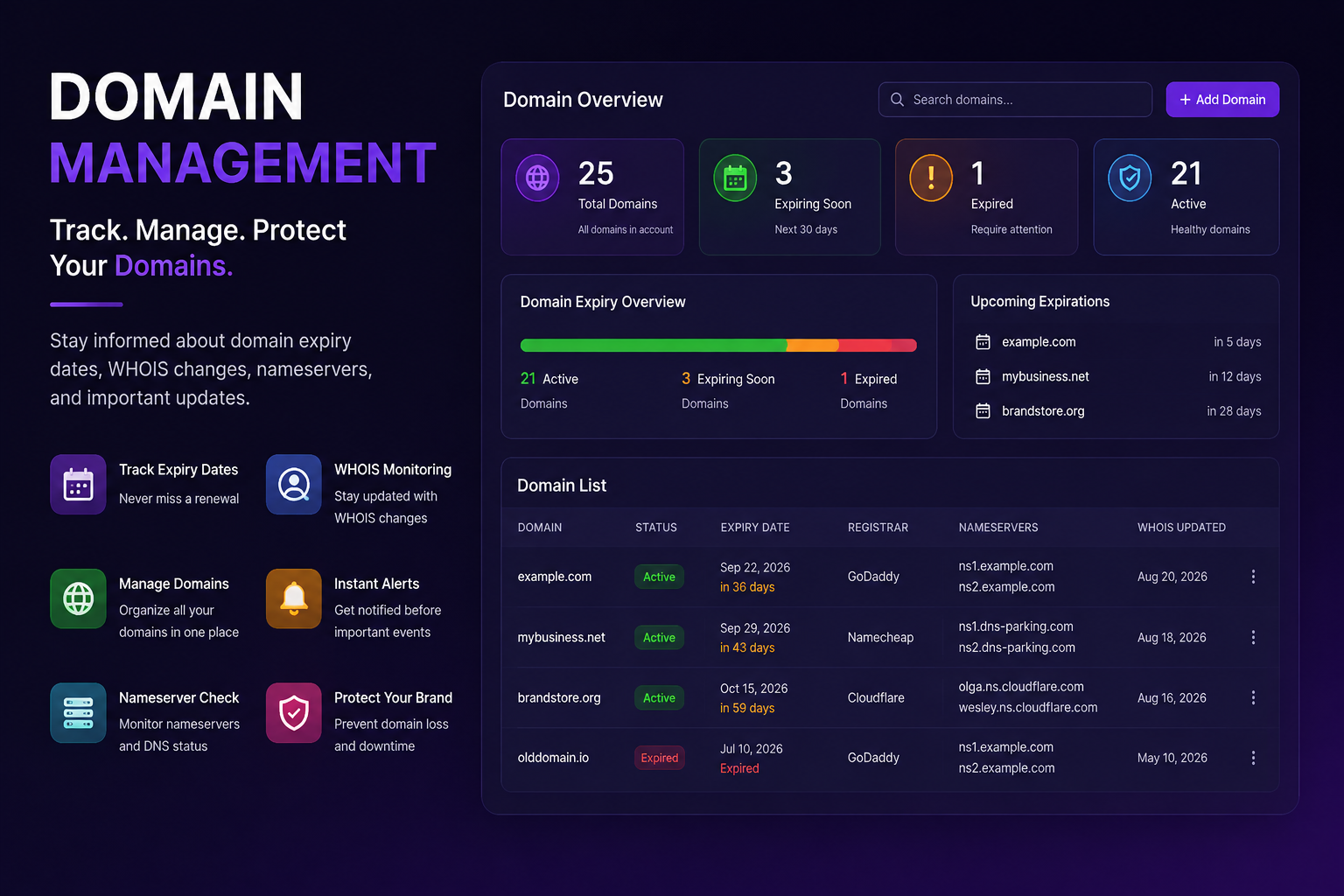
Domain Management: Keep Your Website's Most Important Address Under Control
Your domain name is one of the most important assets behind your online presence. It is the address people use to find your website, access your services, and send email to your domain.

But managing a domain involves more than simply registering it once.
Domains have expiry dates, renewal requirements, registration details, DNS settings, and other important information that can change over time. If these details are not monitored properly, a domain can expire unexpectedly or important changes can go unnoticed.
This is where effective domain management becomes essential.
A proper domain management process helps website owners keep track of important domain information, monitor expiry dates, review registration details, and stay informed about changes that may affect their online services.
What Is Domain Management?
Domain management is the process of monitoring, maintaining, and organizing important information related to a domain name.
This can include:
- Domain expiry date tracking
- Domain renewal management
- WHOIS information monitoring
- Domain registration details
- Nameserver information
- DNS-related domain settings
- Registrar information
- Important domain changes
- Domain availability and status checks
The goal is simple: make sure you know what is happening with your domain before a problem affects your website, email, or other online services.
For a business, developer, agency, or website owner, forgetting about a domain until something goes wrong can be expensive.
Why Is Domain Management Important?
A domain is often the entry point to an entire online infrastructure.
For example, if your domain stops working correctly, it can affect:
- Your website
- Business email
- Customer access
- APIs and applications
- Login systems
- Subdomains
- Brand visibility
- Search engine traffic
Even if your hosting server is running perfectly, visitors may still be unable to reach your website if there is a serious domain-related problem.
That is why domain management should be part of your regular website monitoring strategy.
1. Track Domain Expiry Dates
One of the most important parts of domain management is tracking when your domain will expire.
Every registered domain has an expiry date. If the domain is not renewed before the appropriate deadline, it may eventually stop resolving correctly or become unavailable.
An expired domain can create serious problems, including website downtime and disruption to email services.
Imagine discovering that your business website is unavailable because the domain renewal date was missed.
This is usually preventable.
By monitoring your domain expiry information, you can stay aware of upcoming expiration dates and take action before the domain becomes a problem.
Domain expiry monitoring helps you:
- Know when your domain is approaching expiration
- Plan renewals in advance
- Avoid accidental expiration
- Manage multiple domains more easily
- Reduce the risk of unexpected website disruption
For businesses managing several domains, this becomes even more important. Keeping expiry information organized manually can become difficult as the number of domains grows.
2. Monitor WHOIS Information
WHOIS information contains important registration-related details associated with a domain.
Depending on the domain and privacy settings, WHOIS data may include information such as:
- Domain registrar
- Registration date
- Expiry date
- Domain status
- Nameservers
- Updated date
Monitoring these details can help you understand the current registration status of a domain.
If important information changes unexpectedly, it may require investigation.
For example, unexpected changes to nameservers or registration details could affect how a domain operates.
Regular monitoring makes it easier to notice changes instead of discovering them only after they create a visible problem.
3. Stay Aware of Important Domain Changes
Domain information does not always remain the same.
Over time, changes can occur to registration details, nameservers, domain status, or other associated information.
Some changes may be intentional. For example, a website owner may move to a new registrar or update domain settings.
However, unexpected changes should not go unnoticed.
A domain monitoring system can help website owners maintain visibility over important changes and review them when necessary.
This is particularly useful for:
- Businesses
- Developers
- IT teams
- Agencies
- SaaS platforms
- Website administrators
The earlier an unexpected change is detected, the faster it can be reviewed.
4. Avoid Website Problems Caused by Domain Expiration
Website monitoring and domain monitoring are closely connected.
A website can have excellent hosting and still become inaccessible if the domain expires or experiences a configuration problem.
For example:
Your server: Online
Your application: Running
Your website files: Working
But if the domain cannot properly direct visitors to the correct services, users may still be unable to access the website.
This is why monitoring only uptime is not always enough.
A more complete monitoring strategy should also include domain-related checks.
5. Manage Multiple Domains More Easily
Managing one domain is relatively simple.
Managing ten, fifty, or hundreds of domains is a different challenge.
Each domain may have a different:
- Expiry date
- Registrar
- Registration date
- WHOIS information
- DNS configuration
- Purpose
Some domains may be used for websites. Others may be used for email, applications, redirects, development environments, or brand protection.
Without a clear domain management process, important dates and changes can easily be missed.
A centralized monitoring approach makes it easier to keep track of multiple domains from one place.
Domain Management for Businesses
For businesses, domains are not just technical assets.
They are part of the company's digital identity.
A problem with a primary domain can affect customers, employees, sales, communication, and brand trust.
For example, if customers cannot access:
they may assume the business is unavailable.
If business email depends on the same domain, email communication may also be affected by related configuration issues.
That makes domain management an operational responsibility, not just an administrative task.
Businesses should know:
- Who manages the domain
- Which registrar is being used
- When the domain expires
- Whether renewal is automatic
- What important information has changed
- Whether DNS and domain settings are functioning as expected
Domain Management for Developers and IT Teams
Developers and IT teams often manage domains across multiple environments.
For example:
Each domain or subdomain can play an important role.
A configuration change, nameserver issue, or domain-related problem may affect applications differently.
For this reason, developers benefit from having visibility into important domain information alongside other monitoring tools.
Domain management works well when combined with:
- Website monitoring
- DNS monitoring
- SSL certificate monitoring
- Server monitoring
- Performance monitoring
Together, these checks provide a more complete view of website infrastructure.
How Domain Monitoring Complements DNS Monitoring
Domain management and DNS monitoring are related, but they focus on different parts of your online infrastructure.
Domain Management Focuses On:
- Registration information
- Expiry dates
- WHOIS details
- Domain status
- Registrar-related information
DNS Monitoring Focuses On:
- DNS records
- Nameserver responses
- DNS resolution
- Record changes
- DNS availability
Both are important.
A domain may be active and properly registered, while a DNS configuration problem prevents visitors from reaching the website.
Similarly, DNS records may be configured correctly, but an expired domain can still create major availability issues.
Monitoring both gives website owners better visibility.
What Should You Regularly Check?
A good domain management routine should include reviewing important information on a regular basis.
Check Your Domain Expiry Date
Make sure you know when the domain is scheduled to expire.
Do not rely only on memory.
Review Registration Information
Check important domain and registrar details when necessary.
Monitor Important Changes
Unexpected changes should be reviewed quickly.
Keep Renewal Information Updated
Make sure the appropriate person or team is responsible for domain renewals.
Monitor DNS Separately
Domain registration and DNS are connected but are not the same thing. Both should be monitored.
Keep Multiple Domains Organized
Use a centralized system when managing many domains.
Common Domain Management Mistakes
Forgetting the Expiry Date
This is one of the simplest and potentially most disruptive mistakes.
A domain should never be allowed to approach expiration without awareness.
Using an Old Email Address
Domain renewal notifications may be sent to an outdated or unattended email address.
Important administrative contact information should remain current.
Not Knowing Who Owns the Domain
Businesses should have clear ownership and access procedures.
A domain should not depend entirely on the personal account of a former employee, developer, or agency.
Ignoring Unexpected Changes
Not every domain change is a problem, but unexpected changes should be understood.
Visibility is important.
Monitoring Only Website Uptime
Website uptime monitoring is valuable, but it does not replace domain expiry and registration monitoring.
A complete strategy looks at multiple layers.
How JustChecker Can Help with Domain Management
JustChecker can help website owners maintain awareness of important domain-related information as part of a broader monitoring workflow.
The goal is to make monitoring easier by bringing important checks together.
Depending on your monitoring setup, you can combine domain-related checks with services such as:
- Website Monitoring
- DNS Monitoring
- SSL Certificate Monitoring
- Server Monitoring
- Performance Monitoring
This creates a more complete picture of your online infrastructure.
Instead of waiting for customers to report that something is wrong, monitoring helps you stay informed about potential issues and important changes.
Who Should Use Domain Management Tools?
Domain monitoring can be useful for almost anyone responsible for websites or online infrastructure.
Website Owners
Track important domain information and expiry dates.
Businesses
Protect critical domains connected to websites and business communication.
Developers
Monitor domains and subdomains used across applications and environments.
IT Teams
Maintain better visibility across domain infrastructure.
Digital Agencies
Manage domain information for multiple clients.
SaaS Companies
Monitor domains supporting applications, APIs, dashboards, and customer services.
E-commerce Websites
Help reduce the risk of domain-related issues affecting customer access.
Build a Better Monitoring Strategy
Domain management should not operate in isolation.
For stronger infrastructure visibility, consider monitoring several important layers.
Domain
Check registration and expiry information.
DNS
Monitor records and DNS changes.
Website
Check whether the website is accessible.
SSL Certificate
Track certificate validity and expiration.
Server
Monitor the infrastructure supporting your services.
Performance
Track response times and website performance.
Each layer answers a different question.
Together, they help you understand whether your online services are operating as expected.
Best Practices for Domain Management
Here are some practical best practices:
- Keep track of every domain you own.
- Record domain expiry dates.
- Review renewal settings.
- Keep registrar access secure.
- Use updated administrative contact details.
- Monitor important WHOIS and domain changes.
- Review unexpected nameserver changes.
- Monitor DNS separately.
- Combine domain checks with website monitoring.
- Use centralized monitoring when managing multiple domains.
Final Thoughts
Your domain is the foundation of your online identity.
Customers type it, browsers resolve it, email systems depend on it, and your digital services are often built around it.
Because of this, domain management should not be ignored until something goes wrong.
Tracking expiry dates, monitoring important registration details, and staying informed about changes can help reduce avoidable risks.
A proactive approach gives you better visibility and more time to respond when something needs attention.
With JustChecker, domain monitoring can also work alongside website, DNS, SSL, server, and performance monitoring—helping you build a broader view of your digital infrastructure.
Monitor what matters before it becomes a problem.