What Is a Domain Availability Checker? Complete Guide to Checking Domains
By Super Admin · Sep 2, 2026 · 12 min read
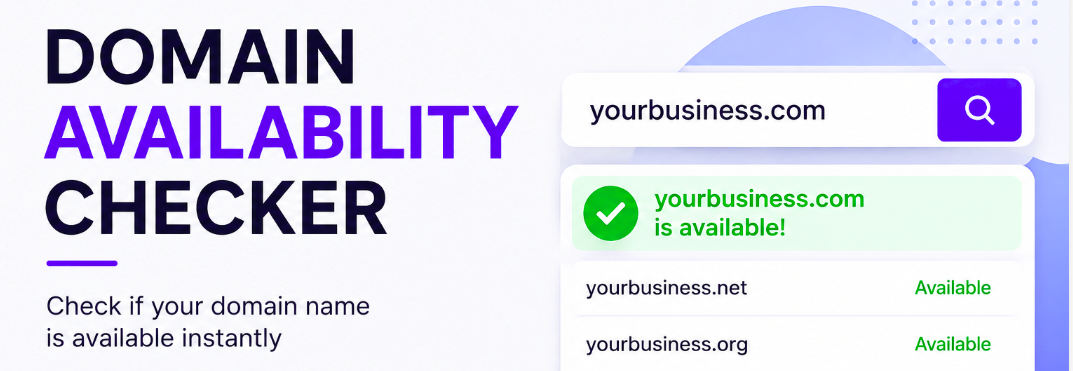
What Is a Domain Availability Checker? Complete Guide to Checking Domain Names
Choosing the right domain name is one of the first steps when creating a website, online business, blog, portfolio, or SaaS product. But before registering a domain, you need to know whether the domain name is already registered by someone else.
A Domain Availability Checker helps you quickly determine whether a domain name is available for registration. Instead of manually searching through different registrars, you can enter a domain such as mybusiness.com and check its current availability.
Check Domain Availability with JustChecker
In this guide, we'll explain how domain availability works, how to check a domain, what WHOIS and RDAP mean, why some domains appear unavailable, and what you should consider before registering a domain.
What Is a Domain Availability Checker?
A Domain Availability Checker is an online tool that checks whether a particular domain name is currently available for registration.
For example, if you want to create a website for a business called "Bright Digital," you might consider:
- justji.com
- ompreminfotech.com
- brightdigital.org
- brightdigital.in
- justchecker.com
The checker helps determine which domain names are already registered and which may be available.
Domain availability can change quickly. A domain that appears available during one search may be registered by another person shortly afterward. Therefore, an availability check is an indication of the current registration status, not a reservation.
Why Is Checking Domain Availability Important?
Checking availability before choosing a domain can save time and help you build a stronger online identity.
A good domain should ideally be:
- Easy to remember
- Easy to spell
- Relevant to your brand
- Short and simple
- Suitable for your target audience
- Available in an appropriate domain extension
For businesses, the .com extension is often preferred because it is widely recognized. However, country-specific extensions such as .in can be useful for businesses targeting India.
How Does a Domain Availability Checker Work?
A domain availability checker generally uses domain registration and public registry information to determine the current status of a domain.
The basic process is simple:
- Enter the domain name you want to check.
- Select or enter the domain extension.
- The system checks available registration information.
- The result indicates whether the domain appears available or registered.
- If unavailable, you can consider alternative names or extensions.
Modern domain lookup systems may use WHOIS, RDAP, registry data, or registrar information depending on the domain extension.
Available vs. Registered Domain
There are two common results you may see.
Available Domain
An available domain is not currently registered and may be eligible for registration through a domain registrar.
For example:
examplebusiness.com — Available
However, availability can change at any time.
Registered Domain
A registered domain is already associated with an existing registration.
For example:
examplebusiness.com — Registered
This does not necessarily mean the domain can never be acquired. The current owner may be willing to sell it, or the domain may eventually expire.
What Are WHOIS and RDAP?
WHOIS has historically been one of the most commonly used systems for checking domain registration information.
RDAP, or Registration Data Access Protocol, is a newer standardized protocol designed to provide structured domain registration data.
Depending on the domain and privacy rules, publicly available information may include details such as:
- Domain status
- Registrar
- Registration dates
- Expiration date
- Nameservers
- Domain status codes
Personal registration information may be hidden because of privacy protections and applicable data protection rules.
What If Your Preferred Domain Is Already Registered?
Don't immediately abandon your brand idea.
You can consider alternatives such as:
- A different domain extension
- A shorter version of the name
- Adding a relevant word
- Using a geographical term
- Using a brand abbreviation
- Contacting the current owner if the domain is genuinely important
For example, if brightdigital.com is registered, you might consider brightdigital.in, brightdigital.co, or another suitable variation.
Avoid creating a domain that is confusingly similar to an established competitor or trademarked brand.
What Are Premium Domains?
Some domain names are classified as premium domains because they are considered highly valuable due to factors such as short length, memorable words, common keywords, or strong commercial potential.
A domain can therefore appear desirable even when it is not available through ordinary registration at the standard price.
Premium domains can cost significantly more than regular domain registrations.
Can an Expired Domain Be Registered?
An expired domain is not necessarily immediately available for anyone to register.
After expiration, a domain can pass through different stages depending on the registry and registrar, such as renewal periods, redemption periods, or deletion processes.
If you're interested in an expired domain, check its current status rather than assuming that expiration means immediate availability.
Check Domain Expiry with JustChecker
Domain Availability vs. Domain Expiry
These are related but different checks.
Domain availability asks:
Can this domain currently be registered?
Domain expiry asks:
When is an already registered domain scheduled to expire?
If a domain is registered, checking its expiry information can help you understand its registration timeline, although expiration does not guarantee that the domain will become available.
Things to Check Before Registering a Domain
Finding an available domain is only the beginning. Before registration, consider:
1. Brandability
Choose a name that can represent your business for years.
2. Spelling
Avoid names that are difficult to pronounce or spell.
3. Trademarks
Search for potential trademark conflicts before using a domain commercially.
4. Domain Extension
Choose an extension appropriate for your business and target market.
5. Social Media Availability
If possible, check whether your brand name is also available on important social platforms.
6. Historical Reputation
For previously used domains, consider checking their history and reputation before purchasing them.
7. Renewal Cost
Don't look only at the first-year registration price. Check the normal renewal price as well.
Why Use an Online Domain Checker?
An online checker makes domain research faster and more convenient. You can test multiple names before deciding which one is best for your business.
For entrepreneurs, developers, agencies, bloggers, startups, and website owners, domain availability checking can become an important part of the website planning process.
Final Thoughts
A Domain Availability Checker is a simple but useful tool for anyone planning to build an online presence. It helps you determine whether your preferred domain appears available and allows you to explore alternatives when your first choice is already registered.
Remember that domain availability is dynamic. Always verify the result with a domain registrar before completing registration, because a lookup does not reserve the domain for you.
If you're researching a new business name, website, startup, blog, or online project, checking domain availability early can help you choose a strong and practical brand name before investing in development and marketing.
50 Frequently Asked Questions About Domain Availability Checker
1. What is a domain availability checker?
A domain availability checker is an online tool that tells you whether a domain name appears available for registration or is already registered.
2. How do I check if a domain is available?
Enter the domain name into a domain availability checker and perform a search. The tool will show the current availability status.
3. Is a domain availability check free?
Many online domain availability checkers offer free searches. JustChecker provides a free domain availability checking tool.
4. What does "domain available" mean?
It generally means the domain does not currently have an active registration and may be eligible for registration.
5. What does "domain registered" mean?
It means the domain is already registered to another registrant or organization.
6. Can I reserve a domain by checking it?
No. Checking a domain does not reserve or hold it for you.
7. Can domain availability change?
Yes. Domain registration status can change at any time.
8. Why is my domain unavailable?
The domain may already be registered, reserved, blocked, premium, or subject to registry restrictions.
9. What is WHOIS?
WHOIS is a system historically used to provide information about registered domain names.
10. What is RDAP?
RDAP stands for Registration Data Access Protocol and provides standardized structured access to domain registration data.
11. Is RDAP better than WHOIS?
RDAP is a newer standardized protocol with structured responses and modern features, while WHOIS is an older system.
12. Can I find the owner of a domain?
Sometimes limited registration information is publicly available, but privacy protections can hide personal information.
13. Can I register a registered domain?
Normally, you cannot register it directly while another registration is active. You may potentially purchase it from the current owner.
14. Can I buy an unavailable domain?
Possibly. The current owner may be willing to sell it, depending on the circumstances.
15. What is a premium domain?
A premium domain is a domain considered especially valuable and may have a higher registration or purchase price.
16. Is .com better than other domain extensions?
.com is widely recognized, but the best extension depends on your brand, audience, location, and business requirements.
17. Is a .in domain good for an Indian business?
Yes. .in can be a suitable choice for businesses targeting customers in India.
18. Should I always choose a .com domain?
Not necessarily. A relevant alternative extension can also work well when .com isn't available.
19. Can I check multiple domain extensions?
Yes. You can check the same brand name across extensions such as .com, .net, .org, .in, and others.
20. What should I do if my .com is taken?
Consider another relevant extension or a carefully chosen variation of your brand name.
21. Should my domain be short?
Generally, shorter domains are easier to remember and type, although relevance and brandability are also important.
22. Should I use hyphens in a domain?
Hyphens can be used in many domains, but a simple domain without unnecessary punctuation is usually easier to remember.
23. Can a domain contain numbers?
Yes, domain names can contain numbers subject to applicable domain rules.
24. Can I use special characters in a domain?
Standard domain names have specific character rules. Some internationalized domains support non-Latin characters through IDN technology.
25. What is an expired domain?
An expired domain is a domain whose registration has reached its expiration point, but it may still go through additional lifecycle stages before becoming available.
26. Does an expired domain become available immediately?
No. It can pass through renewal, redemption, deletion, or other registry-specific stages.
27. How can I check domain expiry?
You can use a domain expiry checker to find available registration and expiration information where publicly provided.
28. Does domain expiry guarantee availability?
No. An expired domain may be renewed by the existing registrant or may pass through other lifecycle stages.
29. Can I register a domain before it expires?
You generally cannot simply register an actively registered domain yourself. Acquisition may require purchasing it from the owner or using appropriate domain acquisition services.
30. Does domain availability affect SEO?
The availability of a domain itself is not an SEO ranking factor. However, your domain choice can affect branding, user trust, and marketing.
31. Does the domain extension affect SEO?
Google has stated that generic and country-code top-level domains are generally handled according to their characteristics; choosing an extension should primarily reflect your audience and business needs.
32. Should I buy several domain extensions?
It can make sense for brand protection, but only if the additional domains provide practical value.
33. Can I check a domain without buying it?
Yes. You can perform an availability lookup without registering the domain.
34. Does checking a domain make it less available?
A normal lookup does not register or reserve a domain. However, because availability can change independently, you should register a desirable available domain promptly.
35. Why did a domain become unavailable after I checked it?
Someone else may have registered it, or the underlying registry/registrar status may have changed.
36. Can I check a domain's registration date?
For many registered domains, registration dates may be available through WHOIS, RDAP, or related domain information.
37. Can I check a domain's registrar?
Yes. Registrar information is often available through domain registration lookup services.
38. What are domain nameservers?
Nameservers identify the DNS servers responsible for providing DNS records for a domain.
39. Can I check nameservers for a domain?
Yes. A nameserver lookup can show the nameservers associated with a domain.
40. What is DNS?
DNS, or Domain Name System, translates domain names into information such as IP addresses and helps internet services locate websites and mail servers.
41. Is domain availability the same as DNS availability?
No. Domain registration availability and DNS configuration are different concepts.
42. Can I check a domain's DNS records?
Yes. DNS lookup tools can check records such as A, AAAA, MX, TXT, NS, CNAME, SOA, and other supported records.
43. What should I check before buying an old domain?
Consider its registration history, backlinks, reputation, previous use, trademark issues, and other factors relevant to your intended use.
44. Can an old domain have a bad reputation?
Yes. A previously used domain may have historical spam, malicious activity, poor backlinks, or other reputation issues.
45. Should businesses check trademarks before registering a domain?
Yes. A domain being available does not mean that the name is legally safe to use as a business or brand.
46. Can I use another company's name in my domain?
You should avoid domains that infringe trademarks or create confusion with an established company or brand.
47. Is domain availability information always accurate?
Availability information can change rapidly, and different registries have different rules. Always confirm availability with an authorized registrar before registration.
48. Can I use a domain availability checker on mobile?
Yes. Most web-based domain checkers can be used from smartphones, tablets, and desktop computers.
49. How quickly should I register an available domain?
If you have decided that the domain is suitable for your business or project, registering it promptly reduces the risk of someone else registering it first.
50. What is the best way to check domain availability?
Use a reliable domain availability checker to research your preferred names, compare extensions, review registration information, and then confirm the final result with a domain registrar before purchasing.